


Every time your reservation notification pings, you probably get a dopamine hit. But have you ever stopped to calculate how much of that booking actually lands in your bank account? For most independent hotels, the answer is terrifying: OTA commissions aren’t just a marketing cost, they are the single biggest threat to your EBITDA.
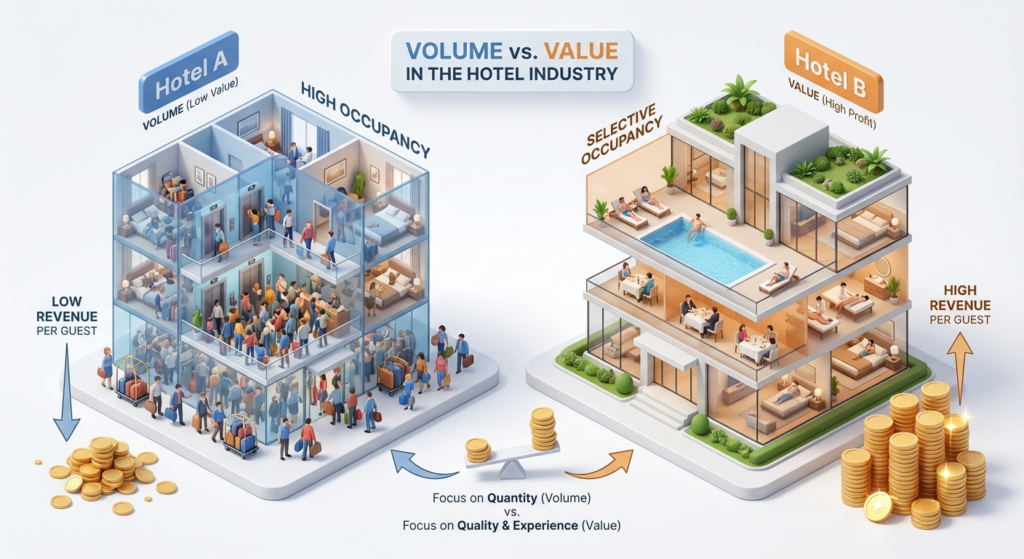
The lobby is bustling. The housekeeping team is running at full capacity. Your occupancy rate is hovering around a healthy 85%, and on paper, your revenue looks solid. Yet, when you look at the bank account at the end of the month, the cash flow doesn’t match the activity level. Where is the money going?
It’s vanishing into the digital ether, wired directly to Amsterdam and Seattle.
For years, hotel owners across the Nordics and EMEA have accepted OTA (Online Travel Agency) commissions as a necessary evil. We treat the 15–20% cut taken by Booking.com and Expedia as a “marketing tax”—the cost of doing business. But it’s not a tax. It is a dependency that is bleeding your profitability dry.
At Resaco, we are obsessed with revenue growth. But revenue without profit is just vanity. True growth means keeping more of what you earn.
In this analysis, we are going to do the math that the OTAs hope you never do. We will break down exactly how a standard commission structure cannibalizes your net profit, why the industry landscape has shifted regarding rate parity, and how you can reclaim that margin.
This isn’t about deleting your Booking.com account today. That would be suicide. We simply want to show you the reality of your P&L and realize that your “partner” is actually your most expensive employee.
Let’s start with the numbers you can see. Every month, you receive an invoice from Booking.com. It’s usually a painful moment, but most hoteliers glance at the total, grimace, and pay it.
To understand the scale of this financial drain, we need to look at a hypothetical, yet entirely typical—scenario. Let’s look at “Hotel Aurora,” a successful 35-room boutique property in Finnish Lapland.
The Calculation: If 65% of the €2M revenue comes through OTAs, that means €1,300,000 of the hotel’s income is subject to commission.
The Reality Check: Take a moment to let that number sink in. €234,000.
That is not “marketing spend.” That is the annual salary of a General Manager, a Sales Manager, and a part-time marketing coordinator combined. That is the cost of renovating 10 bathrooms. That is pure margin, leaving your business.
And what did you get for nearly a quarter of a million euros? You got bookings, yes. But you didn’t get the customer data or the brand loyalty. You rented a customer for a night, and you paid a premium to do it.
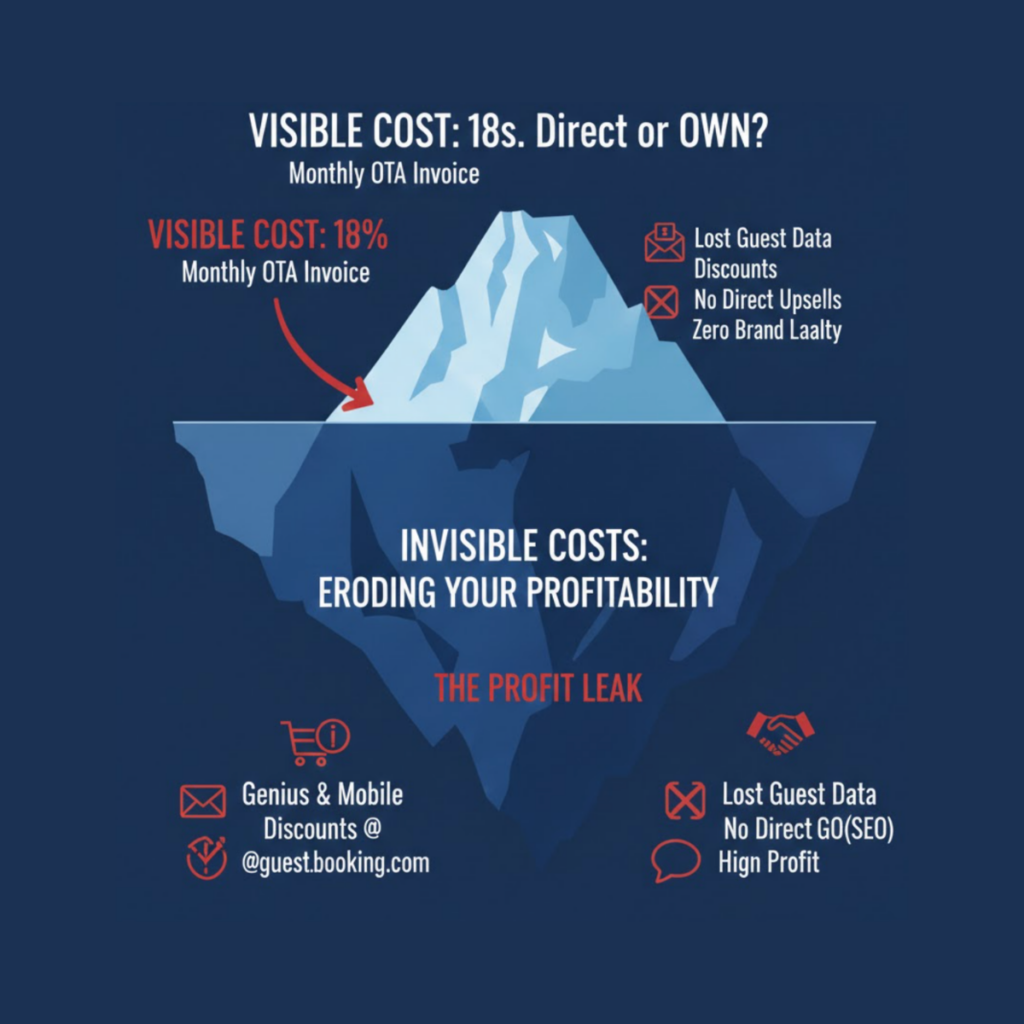
If the monthly invoice was the only cost, the situation would be bad, but manageable. Unfortunately, the €234,000 figure is just the tip of the iceberg. The real damage to your hotel’s financial health happens below the surface, affecting your Average Daily Rate (ADR) and Guest Lifetime Value (GLV).
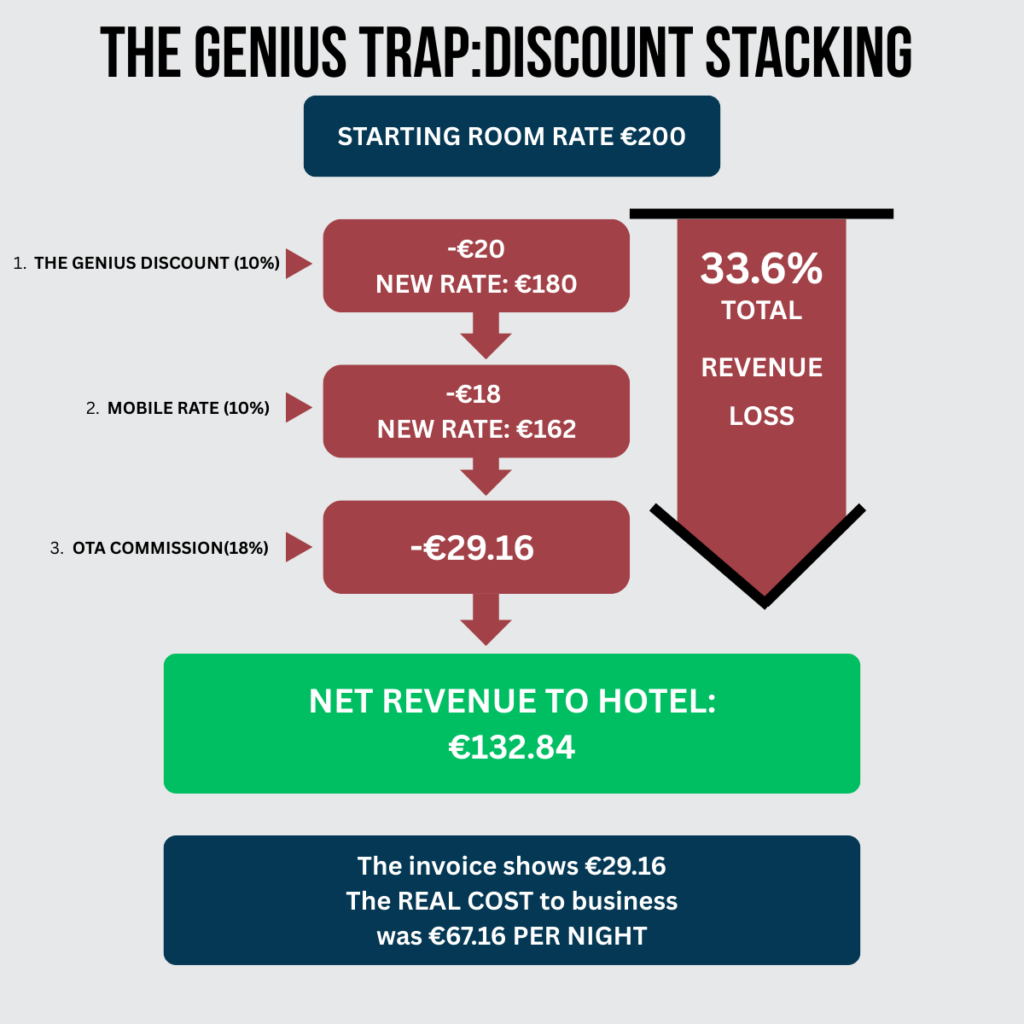
Booking.com’s Genius program is a masterclass in psychology. To be visible on the platform, you are encouraged to join Genius Level 1, offering a 10% discount to users. Then, you are nudged to offer a “Mobile Rate” to capture phone bookings, typically another 10% off.
The Math of Stacking: Discounts on these platforms are generally applied multiplicatively. Let’s say your room rate is €200.
Now, Booking.com takes their commission on the final price.
Net Revenue to Hotel: €132.84.
You started with a €200 room. You received €132.84. That is a 33.6% reduction in revenue.
The invoice only shows the €29 commission. But the real cost to your business was €67.16 per night. You are simply eroding your pricing power.
When a guest books through an OTA, they are not your customer. They are Booking.com’s customer.
OTAs protect their asset, the user data, by masking guest email addresses (using aliases like <guest-alias>@guest.booking.com). This creates a Data Blackout that costs you money in two specific ways:
To the OTA guest, your hotel is a commodity filtered by price and location. They didn’t fall in love with your brand story; they fell in love with the deal.
This makes it difficult to build Guest Lifetime Value (GLV). Internal data from Resaco clients consistently suggests that direct booking guests have significantly higher lifetime value than OTA guests, often because you own the relationship and can drive repeat visits without paying a “toll” every time.
This is where the math gets uncomfortable. You don’t pay your bills with revenue. You pay them with Profit.
To understand the true impact of OTA commissions, we must look at them in relation to your EBITDA (Earnings Before Interest, Taxes, Depreciation, and Amortization).
Let’s go back to Hotel Aurora.
Scenario A: Direct Booking
Scenario B: OTA Booking
The difference is €26 per night.
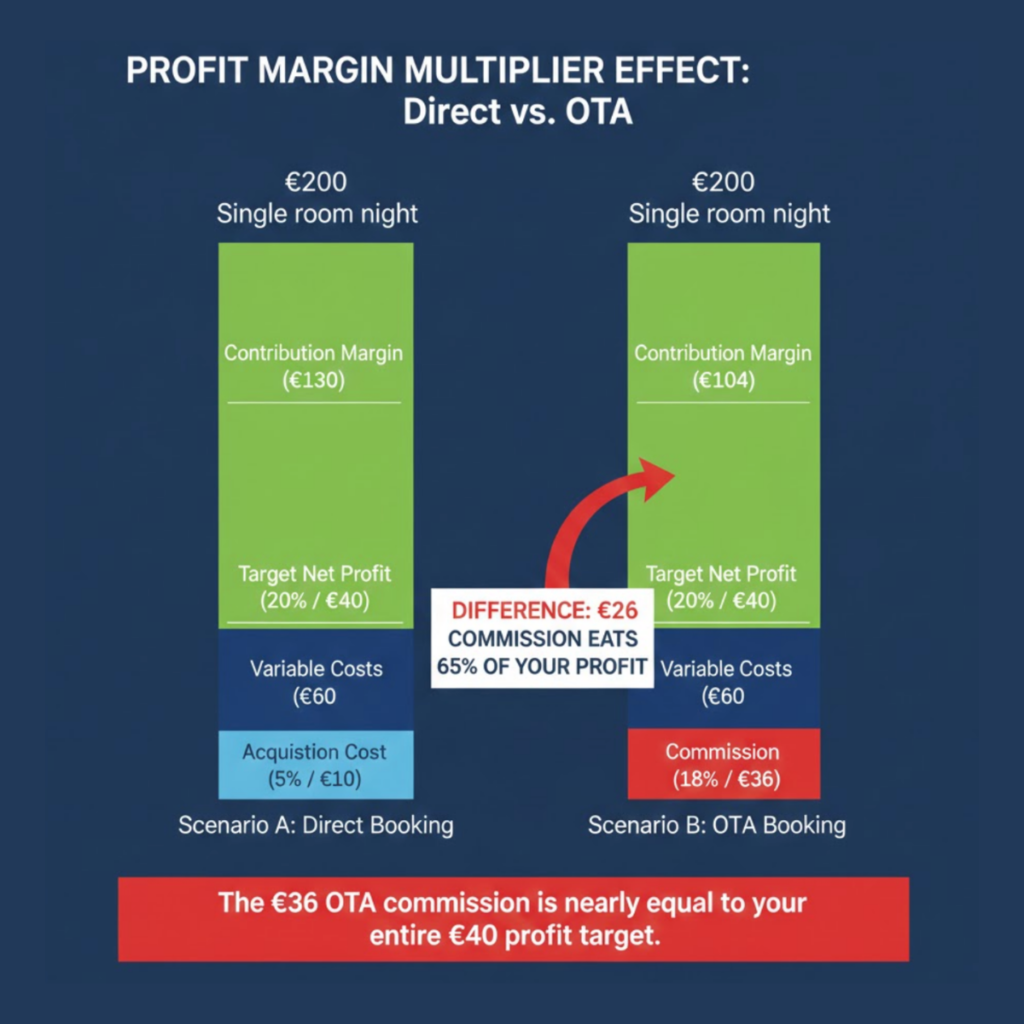
It doesn’t sound like much until you scale it against your profit targets. If your hotel aims for a healthy 20% Net Profit Margin overall (€40 on a €200 room), the OTA commission of €36 is nearly equal to your entire target profit.
When you pay 18% of revenue to an OTA, you aren’t giving them 18% of the pie. You are often giving them 50% to 90% of your actual Net Profit from that booking.
We hear this objection constantly: “But if I’m not on Booking.com, I don’t exist. People see me there and then book direct.”
This is the “Billboard Effect.” While industry studies from a decade ago validated this, data from 2024 and 2025 suggests the effect has diminished and evolved.
Why? The OTAs closed the loop. Their apps are fast, save credit card details, and offer loyalty perks (Genius/OneKey) that keep users inside their ecosystem. If your website is slow or hard to navigate on mobile, the user will treat your site as a brochure—check the photos, then go back to the app to book.
However, the legal landscape has changed in your favor. Following the implementation of the Digital Markets Act (DMA) in the EU, gatekeeper platforms like Booking.com can no longer enforce “narrow” parity clauses. You are now legally allowed to offer lower prices on your own website.
The question is: Are you using this freedom?
The solution is not to disconnect your hotel today. OTAs serve a purpose for reaching new markets and filling last-minute inventory. The goal is rebalance, not elimination.
We need to shift your dependency ratio.
How do we move 30% of your bookings from high-cost channels to low-cost channels?
The Impact of the Shift: If Hotel Aurora shifts just 20% of its OTA bookings to Direct:
That is €52,000 straight to your bottom line. That’s your new kitchen. That’s your staff bonus. That’s your profit.
The hospitality industry has been lulled into complacency, accepting that giving away 18–20% of revenue is “just how it works.”
It isn’t.
Every 10% shift from OTA to Direct adds tens of thousands of euros to your EBITDA. But you can’t fix what you don’t measure. You need to know exactly how much the OTA tax is costing you—not just in monthly invoices, but in lost profit and lost lifetime value.
Stop guessing. Stop accepting the “tax.” It’s time to take control of your distribution.
Do you know exactly how much margin you’re losing this year?
We have built a tool specifically for independent hotels to visualize this loss. Plug in your revenue, your commission rate, and your dependency ratio, and see the uncomfortable math for yourself.


"*" indicates required fields

Visiting address
Hallituskatu 26, 2. krs
96100 Rovaniemi
Finland
Postal address
Evakkotie 48 A 5
96100 Rovaniemi
Finland
Business ID: 3259870-5
VAT ID: FI32598705
E-invoicing address: 003732598705
Operator: Apix Messaging Oy (ID: 003723327487)
Olli Junes
olli.junes@resaco.fi
+358 45 671 7116
Tiia Lehtisalo
tiia.lehtisalo@resaco.fi
+358 44 096 1407
Linkedin
Instagram
TikTok
"*" indicates required fields
"*" indicates required fields
"*" indicates required fields
