


High hotel occupancy is a vanity metric if your cost of acquisition is destroying your margins. When an 85% occupancy rate relies on OTA bookings with 15–25% commissions, your Gross Operating Profit Per Available Room (GOPPAR) often drops below that of a competitor with lower occupancy but a healthier direct booking mix. Profitability, not capacity, is the only metric that matters.
The lobby is buzzing. The front desk staff is scrambling to check in a busload of arrivals. Housekeeping is running on overtime to turn rooms around. To the casual observer, and perhaps even to your board of directors—business is booming. You hit 85% occupancy this month. The “Sold Out” sign is up.
It feels like success. It looks like success.
But when the P&L arrives at the end of the month, the celebration stops. The bottom line is razor-thin. The EBITDA doesn’t match the energy in the lobby.
Why? Because you didn’t earn those guests. You bought them.
For too many General Managers across EMEA, occupancy has become a dangerous vanity metric. The uncomfortable truth is that a full hotel paying 20% commission on every room is often less profitable than a 70% occupied hotel that owns its demand.
At Resaco, we are obsessed with revenue growth, real revenue that stays in your bank account, not revenue that passes through your hands on its way to Booking or Expedia. It is time to stop celebrating being “full” and start obsessing over being profitable.
Here is the uncomfortable math behind your occupancy rate.
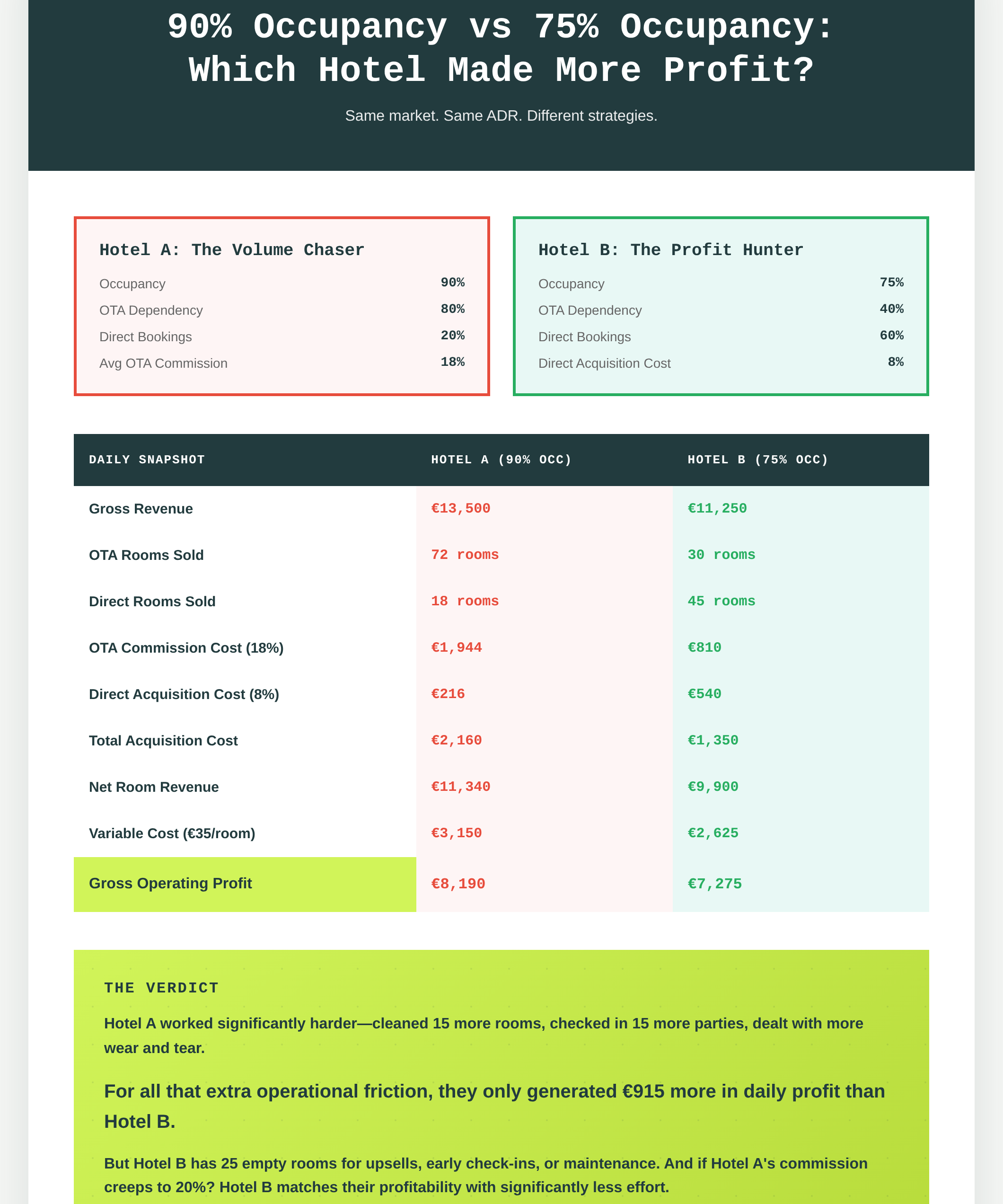
Let’s strip away the emotion and look at the raw numbers. In hospitality, volume is often confused with value. To illustrate this, let’s compare two hypothetical properties in the same market, with the same room count and the same Average Daily Rate (ADR).
For decades, the industry standard metric has been RevPAR (Revenue Per Available Room). While RevPAR remains a vital benchmark for top-line performance and market share, it is insufficient for assessing true financial health because it ignores your single biggest marketing expense: commissions.
RevPAR tells you how well you filled the hotel and at what price. It tells you nothing about how much money you actually kept.
Traditional revenue management systems (RMS) often optimize for RevPAR. They trigger price drops to spur demand when pickup is slow, often feeding that inventory directly to high-cost OTA channels. The algorithm sees “more revenue,” but the bank account sees “more expense.”
If your Revenue Manager reports RevPAR without context, they provide a partial picture. You might be flying fast, but you are burning fuel at an unsustainable rate.
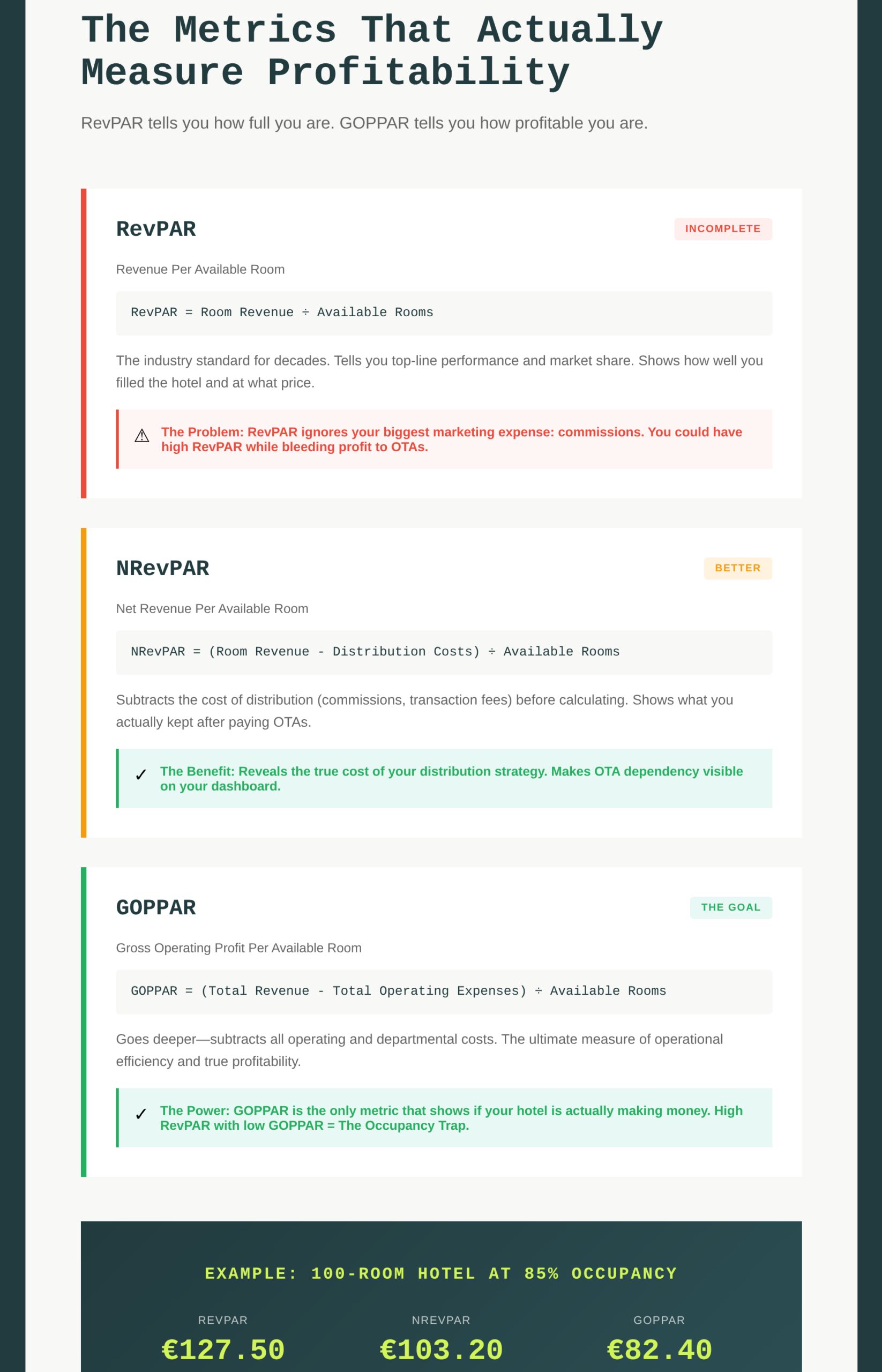
Actionable Insight for the Growth GM: In your next board meeting, change the slide deck. Present GOPPAR and NRevPAR alongside RevPAR. When a board member asks why occupancy is down year-over-year, point to the profit line: “Occupancy is down because we stopped buying low-quality, high-cost revenue. But look at the profit—we are doing less work for better margins.”
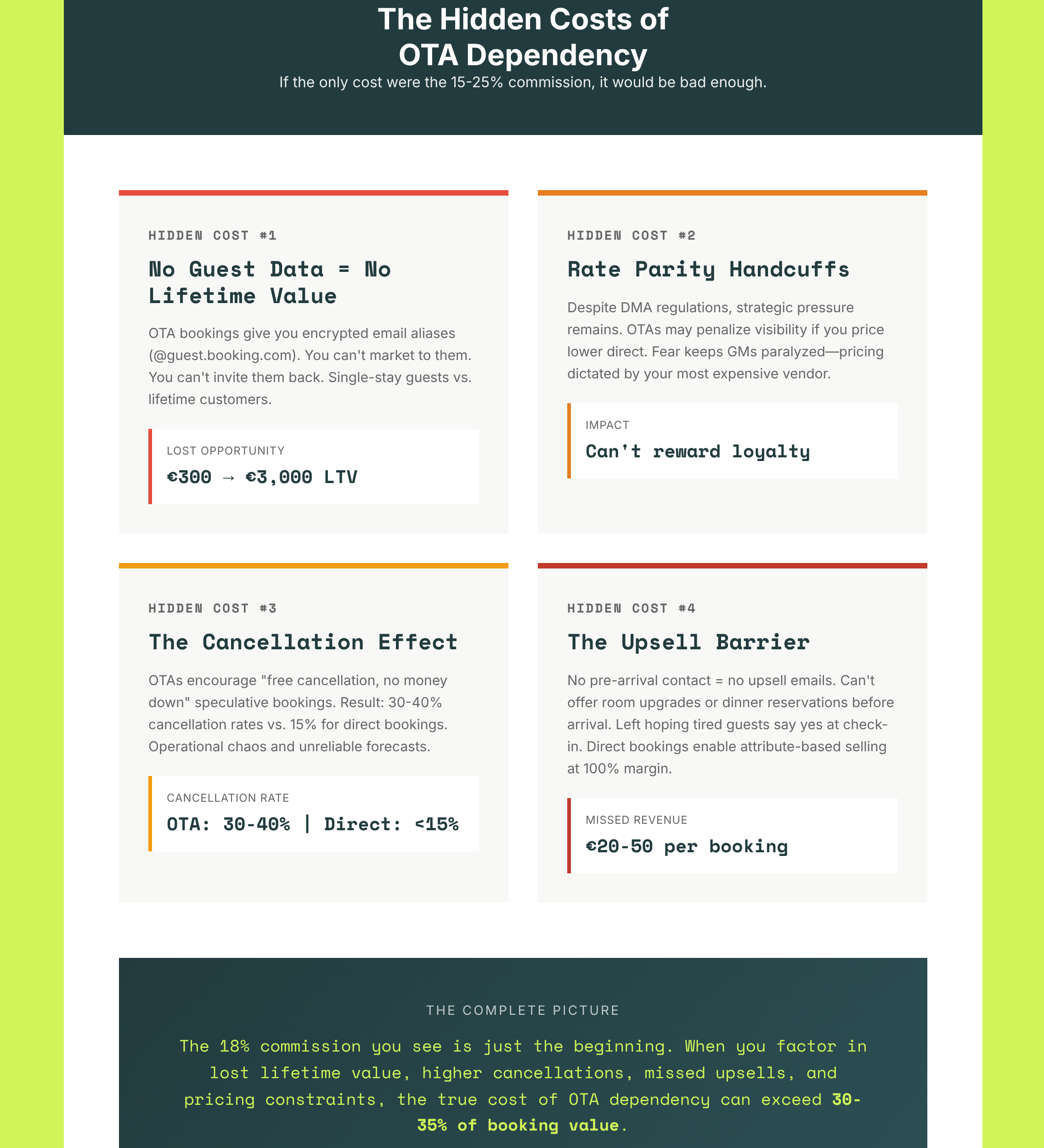
If the only cost of OTA dependency were the 15–25% commission invoice, the situation would be bad enough. But the damage goes deeper.
While this profitability crisis is global, the pain is felt acutely in high-cost operating environments like the Nordic countries.
If you run a hotel in Helsinki or a resort in Lapland, you deal with some of the highest labor costs in the world. Energy costs for heating during the long winter are substantial. Your breakeven occupancy is naturally higher than a hotel in a market with lower operating expenses.
In this context, margin erosion is fatal. A hotel in a low-cost labor market might survive giving away 20% to an OTA. In Finland, where labor costs are significantly higher, that 20% commission cuts directly into the bone.
You simply cannot afford to outsource your customer acquisition when your operating base is this high. In the Nordics, a direct booking strategy is a survival mechanism against rising costs.
We are realistic. We are not suggesting you disconnect from OTAs tomorrow. That would be unwise. OTAs serve a purpose: they provide visibility (the “Billboard Effect”) and fill distressed inventory.
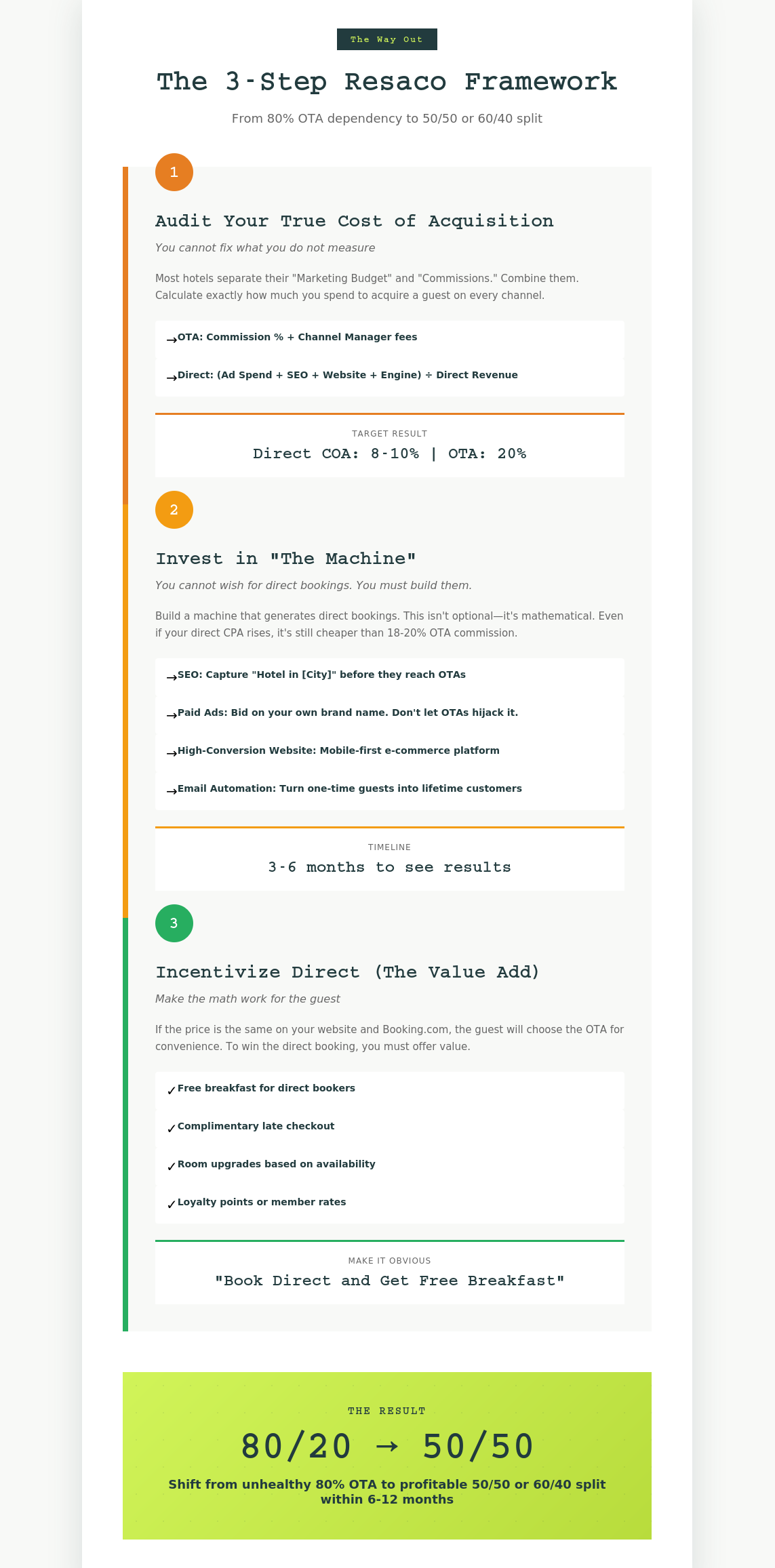
The goal is OTA reduction, not elimination. It is about shifting from an unhealthy 80/20 split to a profitable 50/50 or 60/40 split. Here is the 3-step Resaco framework.
The hospitality industry has allowed itself to be lulled into complacency by high occupancy figures. We have allowed technology companies to insert themselves between us and our guests, skimming the cream off the top of every transaction.
An 85% occupancy rate is meaningless if it doesn’t result in a healthy bank balance. A “Sold Out” night is a failure if you paid a ransom to achieve it.
At Resaco, we help hotels verify the uncomfortable math and build the infrastructure to change it. We don’t deal in vanity metrics. We deal in EBITDA. We deal in GOPPAR. We deal in Control.
You built the hotel. You hired the staff. You pay the heating bill. You deserve to keep the profit.
Most GMs only look at the monthly commission invoice. But that is just the tip of the iceberg. Our Hidden Costs of OTAs Checklist reveals the financial leaks eating your EBITDA right now.
Not necessarily. While high occupancy helps cover fixed costs, it increases variable costs (housekeeping, utilities). If the marginal revenue from those extra rooms is largely consumed by high OTA commissions and variable costs, you put strain on your operation for very little actual profit. Selling fewer rooms at a higher margin (Direct) often yields a better bottom line.
You don’t have to compete with their entire budget. You only have to compete for the specific traveler looking for your hotel. OTAs market the world; you market your property. By focusing on “Brand Protection” (bidding on your own name) and local SEO, you can win the high-intent guest without spending billions.
The industry average for independent hotels often hovers around 20–25%. However, a “healthy” mix for a well-optimized property should target 40–50% direct bookings. Every percentage point you shift from OTA to Direct adds immediate profit to your P&L.
RevPAR (Revenue Per Available Room) looks at revenue relative to capacity. GOPPAR (Gross Operating Profit Per Available Room) looks at the actual profit made after expenses. Hotel A might have higher RevPAR but lower GOPPAR due to high commissions. Hotel B is the better business.
OTAs market heavily on “flexibility” and “free cancellation.” They encourage users to book multiple hotels for the same dates and decide later. Direct bookings often require a bit more commitment (like a deposit), meaning the guest is statistically more likely to show up.
Resaco, a digital marketing agency obsessed with revenue growth. We help hotels and tourism operators across EMEA build direct booking engines that reduce OTA dependency. Founded in 2022, we operate remotely across 5 countries.


"*" indicates required fields

Visiting address
Hallituskatu 26, 2. krs
96100 Rovaniemi
Finland
Postal address
Evakkotie 48 A 5
96100 Rovaniemi
Finland
Business ID: 3259870-5
VAT ID: FI32598705
E-invoicing address: 003732598705
Operator: Apix Messaging Oy (ID: 003723327487)
Olli Junes
olli.junes@resaco.fi
+358 45 671 7116
Tiia Lehtisalo
tiia.lehtisalo@resaco.fi
+358 44 096 1407
Linkedin
Instagram
TikTok
"*" indicates required fields
"*" indicates required fields
"*" indicates required fields
